Posts

Hackathon: TechTogether Boston

Image
iOS app Last weekend, I had the wonderful opportunity to participate in Boston's largest all-female and non-binary hackathon! A group of friends and I wanted to digest as much tech and nerd information as possible, and we basically made it our mission to go to nearly every workshop session offered for two days straight. I don't know how we managed this but we did. From 5p on Friday and all day on Saturday, it seemed I bounced from one room to the next with a nap here and there. There was a workshop on rapid prototyping with AdobeXD -- which I am in love with. Then, I was able to create my first phone application during a workshop on iOS app development with Swift  (it's much easier than I had imagined), followed by a workshop at 2am on Android app developmen t. For my very first hackathon-conference, I wanted to focus on skill development and learning, rather than the competition. However, seeing everyone so wrapped up in their individual designs and programming ...

Women of Color in Graduate School

Image
Recently, I've been asked (by a few people) how it feels to go through graduate school as a woman of color. And, to be completely honest, it's incredibly exciting and exhausting all at the same time. Being a woman of color -- specifically a black woman, particularly in STEM -- has a lot of challenges. If you simply search the phrase "black in graduate school," you will get statistics that are very humbling; articles and think-pieces on how different the Black or person-of-color experience is from students who are not minorities; and other outlets detailing how little support many Black and non-Black students of color feel that they have. In fact, the Council on Graduate Schools recently reported that, in 2017, Black students made up just 11.9% of all first-time graduate students in the United States. (That said, 68% of them were women! So, we are making p r o g r e s s.) I'm not sure what the numbers are at Boston University, but it doesn't seem that far o...

SECON 2019

Image
One of the cool perks of my job is the ability to go to conferences. I haven't used it very often, but that perk allows me to stay abreast of all the cool technological and business innovations happening in the field. It's a win-win since (1) it helps me conduct better research for the team and (2) it allows me to nerd out in ways that I probably would not be able to afford on my own. Last weekend, I checked out the 2019 Social Enterprise Conference  (SECON19) at the Harvard Business School, featuring Anand Giridharadas. You might recognize him as the author of  Winners Take All, The True American, and India Calling . (It was my first time hearing him speak, and I was absolutely amazed -- and somewhat stunned -- at all of the facts he regularly dropped about the system behind American wealth.) The conference was filled with all types of relevant topics, from workshops on entrepreneurship, capital building, and impact to several panels on creating innovative c...

Truss Design (Final)

Image
We finally made it to the end! After the preliminary design report, it was time to finalize our actual design (since we were given enough materials to make one truss to test). After doing a few more draft sketches and analysis, I was able to pick up on patterns on which types of designs produced the maximum strength (all within the parameters we were given). Finally, I came up with the sketch at the bottom-right, and the MATLAB analysis produced the highest load we were able to reach. We theorized that: two members would buckle first instead of just one (Members 3 and 4); the maximum load is 11.62 ± 0.063N; and the total cost of the truss is $290 (under the budget limit). From there, we moved to prototyping: we cut the straws as close as possible to the lengths specified in our final design. To create uniform gusset plates, our "joints," we used the circular cap of an individual Tropicana Orange Juice bottle. It met the area requirements and acted as a stamp...

CAD Final Project 03

Image
Planetary Carrier Somehow I was able to use Creo to create all of the components of the gearbox in one day (not recommended). After destructing the B&D Li2000, opening up the gearbox (which took a bit of strength), and calculating the measurements of each component, I was finally able to re-create all of the parts. Ring Gear Then, with each individual design, attach the components to one another in assembly (left) so that the kinematics or the motion of the CAD-assembled gear train resembled that in the gearbox. Planet Gear Additionally, I was able to use the motion analysis feature in Creo to model the pitch diameters and gear ratios for the cylinders representing each gear. (We did not go into depth on how to actually create the teeth on the gear since it requires manufacturing details we did not have.) Sun Gear Below is a video demonstrating the mechanism analysis for a multi-stage epicyclic gear train like the one used in the B&D Li2000 Screwdri...

CAD Final Project 02

Image
Motor and Case So, in the most recent lectures, we've talked a lot about what is called " Design for Manufacturing and  Assembly (DFMA) " -- or the combination of designing for the ease of manufacture and designing for the ease of assembly. Even the best assembly process in the world can fail under human errors like fatigue, time pressure, and plain carelessness. (We've all accidentally dived into an Ikea furniture assembly without fulling reading the instructions beforehand.) Hence, wisely, product designers tend to use 'mistake-proofing' features in order to make those kinds of careless mistakes obvious within seconds. Like a puzzle, either a piece fits or it doesn't. Otherwise, you'll end up with a deformed piece and an unclear final product. Honestly, those small DFMA pieces like a raised section of plastic can make or break how well-connected a handle is -- or even how easy it is to replicate the same level of quality that the company is promi...

CAD Final Project 01

Image
So ME359 has been great but it has been an exercise in stamina . For a 2-credit class, where weekly homework is 70% of your grade, this is a lot of time and energy -- but, still, exciting. Like I said before, I do really well when it comes to project-based learning and real-world applications. And this course's final project has really been wonderful for that. The final project is to reverse engineer the Black and Decker Li2000 Screwdriver and then use the computer-aided design (CAD) software Creo to re-create the gearbox. This is an interesting task since the B&D Li2000 uses a planetary gearbox, which consists of three types of a gears that all lie on the same horizontal axis. My task is to create the ring gear (the outermost gear), the three pinion gears that rotate around that inner radius of that ring, the sun ring around which the pinion gears rotate, and, then, the planetary gear connected to the central axis of the screwdriver. Ultimately, I need to create all of ...

Truss Design 02

Image
The second part of the final project for EK301 (Mechanics) consists of a preliminary design -- or, rather, several preliminary designs and one identified draft. Having the data from the straw lab test and the resultant code to determine the approximate load that a straw can hold based on its length, it took quite a bit of creativity to find the perfect combination of straws. However, to simplify this process, the class was instructed to use a MATLAB code that would take a design and then indicate which member of the truss would fail first. It is important to note that all designs were given the same parameters: Figure: One of two designs selected The truss must be a single, planar, simple truss.  Members must be joined concurrently at joints using the provided pins and double pinned to the guest plates.  Gusset plates may be any geometry but must have an area of less than 16 sq. cm. All joint-to-joint distances must be at least 10 cm and no longer than 16 cm. The ...

Truss Design 01

Image
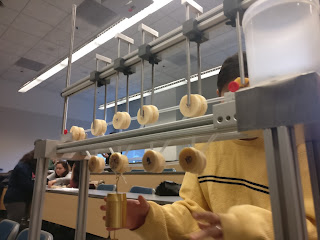
Testing Apparatus for Straw Lab Fall 2018 has been off to a very strong start. Being back in an academic environment is both really challenging and very inspiring. It has been tough to balance a full-time course load with a part-time job, but, so far, being able to still do classes like EK301 (Mechanics) has been rewarding. I missed creating designs and prototypes more -- much more -- than I realized. The truss design project that I just started has really switched on the engineering light bulb. I am not a huge fan of the traditional, exam-based learning that most engineering classes use, but these little peaks into applications and projects (which is how I fell in love with engineering) makes it all worthwhile. The final project started off with a lab test on the straws my group will use to design a sturdy bridge or 'truss.' The straw lab required lots of attention to detail and control, and, fortunately, I was able to stay later to complete the remaining tests and ...

Back in Business

Image
So, hey... I'm in grad school! Life is going great. Last year -- the year after graduating from Wellesley College -- was a whirlwind, and settling into the world as a post-graduate is much more difficult than I had thought. My sincere apologies to anyone following this blog, only for it to be really left behind. Long story, short: "Christina made into an amazing program at Boston University College of Engineering as a MechE (Mechanical Engineer) -- and she is living her best life!" Yet, if you still want to know what has happened in my life. Let me give you all a short recap of 2017-2018. Last Semester of College (Winter - Spring 2017) I was accepted into the Madeleine Korbel Albright Institute for January 2017. And, it was absolutely phenomenal. Every day was a new topic of contemporary politics and high-profile policies. On top of that, we were also pushed to conduct a rigorous case study in those four weeks. (Take a peek here . ) The administrators (righ...

New Year!

Image
Wow... it's already the end of December and New Year's Day is right around the corner. I'm thankful for a lot this year: I was able to travel again, help people learn about design and their own potential, develop more skills, discover more about myself.... and, despite numerous challenges and some disappointments, I'm still pushing forward. I know I neglected this blog during the fall semester. (Sorry.) However, I hope to pick things up again in the spring. I'm coming up on my final and last semester in college -- which sounds just as crazy to me as it probably does to you. **Recap**  I did finish my report,  An overview of economic theory and approaches for evaluating the productivity of water on Santiago Island in Cape Verde, from this summer with INIDA. Hopefully, I can publish out-of-house too. Also, I presented at the 2017 Tanner Conference on my activities in Cape Verde this summer, and it seems that a number of people liked my brief talk. Then, this fall...

Brainstorming Workshop @ UniCV

Image
This Friday, I took a step to introduce the WeLab teaching style by forming a brainstorming workshop between the UniCV engineering professors and students - and it was a  HIT!  A few days before we prepped by going over the brainstorming activity (below) Professor Banzaert did in my first class with here: what materials do we need, how will we use the most of an hour, what should the environment/vibe feel like, etc. I even got Paulo to agree to help breakdown the formal professor-student division that Cape Verde (and most schools everywhere) cling too. The day of, I was expecting each professor to bring maybe 1 or 2 students but there were  so  many people (20-30 people). After doing a brief presentation on Wellesley (same ECAA presentation) and the brainstorming rules (below), we had to break down into smaller and smaller groups for the activities. Even better, everyone who came was engaged and even wanted to stay longer to fuel more ideas and connections as ...

Project Scouting: Hydroponics 02

Image
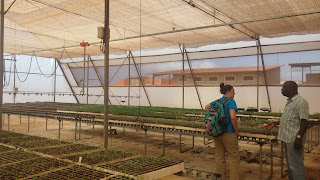
Wednesday, we returned to the Hydroponics Center for a second visit. The director Joao quickly whipped up a meeting with a few staff members so we could sit down and talk more about Wellesley and the potential for collaboration. In addition to him, we spoke with one of the engineers there, a social scientist and an intern to ask them about their work and their ideas for the future. It started off a little slow since I think people were shy but then picked up pace as Mackenzie and I started seeding ideas and others built off of them. It's one thing to talk about thoughts at a table but it's another thing to actually see them. Together, we gathered a list of potential topics to explore there and then they led us outside to show us the topics they talked about: Investigation of renewable, sustainable energy sources (Solar and/or Wind).  They have several large machines necessary in seed sorting/planting, soil mixing, irrigation regulation, and daily office functions ...

WP: Farmer Interviews 02

Image
The second day of interviews was definitely the best! Although many spouted their opinions to us on farmers using traditional irrigation (instead of gota-gota/drip irrigation), it was absolutely amazing to see it in action/finally understand the system and talk to the farmers directly on why they have stuck with traditional systems. We got different opinions and I absolutely want to hear more from that target: We also spoke with two more gota-gota farmers. One is the only member of farmers' association using gota-gota; The other owns a private - and exporting - company. (Note:  Again, all of these farmers are allowing us to use photos and names. ) First things first, traditional irrigation is referred to as " alargamento ," and you really won't understand it unless you see it. This technique is ancient ("since Adam and Eve" as one farmer said) and, generally, farmers learn it from their fathers. We were so lucky to see it in action, because, when you...

Water Productivity: Farmer Interviews

Image
So the following two days were filled with interviewing farmers (in different municipalities and of different backgrounds and resources). And to be honest, it was the most useful thing we've done/seen here. A lot of people can talk and read about practices in Cape Verde but it is entirely different to be there to experience it and talk with the people directly. I believe "going to the source" is the most useful way of understanding anything new. So that's what we did for three days this week. We started off close to the office, speaking with two farmers ( both of whom are allowing us to use their names in publications ). The first, clearly, had experience and resources with farmer and proudly proclaimed he was the one to teach and start strawberry farming on the island. Brief profile (or take-aways): 6 hectares  of very hilly land ( boy, did we walk... ); 3 wells and 5 tanks with programming system for irrigation Believes government should have more dams: says...