Posts

Showing posts with the label Energy

Reflections on Final Project

Image
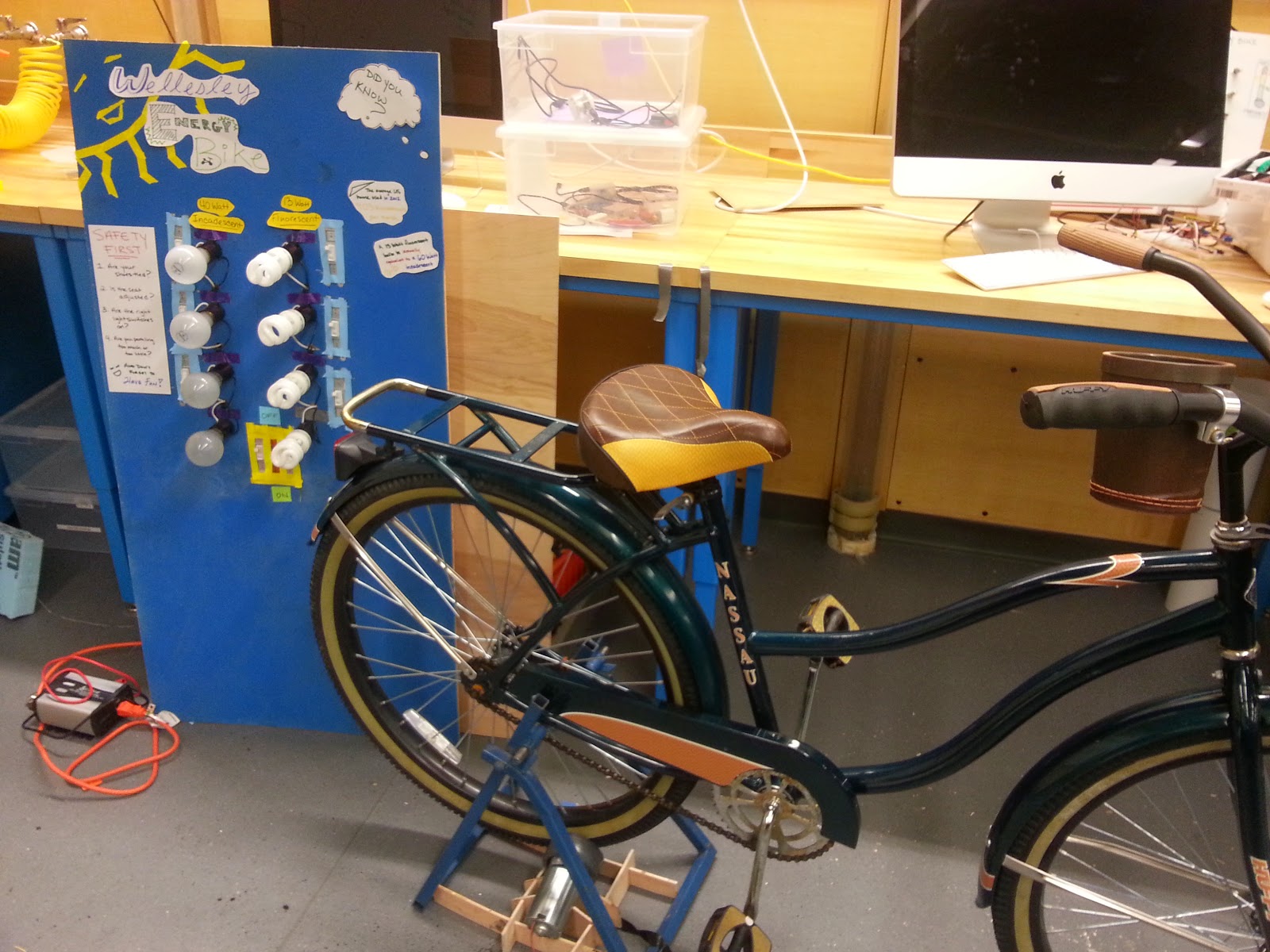
(L to R, Christina and Kat with the Wellesley Energy Bike) Last week, my partner Kat Roche and I finished our final design of the Wellesley Energy Bike display and got to show it off in the science center during the exhibition. In general, I think the project came out well despite all the difficulties: participants really felt the difference between bulb types as they were pedaling and viewers saw the difference in effort. To summarize the design process: We sketched out all our ideas of how to bring sensors into an interactive display about energy. We broke down the design into three parts: works-like , looks-like and learns-like . Then, we began building and experimenting with different mechanical/electrical functions: Back wheel was raised off the ground using a bike stand and placed flushed against the PVC wheel attached to the permanent-magnet motor  The axle turned along with the wheel and transferred mechanical energy into electrical energy from the s...

Creating the Final: Works, Looks, and Learns-Like Model

Image
Kat and I are so excited for today's engineering exhibition.  Come see the interactive, educational display at 2pm in the Focus area (1st floor of the Science Center)! Charge Your Laptop Power a Hair Dryer Yesterday, we placed the final touches: the hair dryer, the energy facts and descriptions, the switch covers, etc. We were so surprised that we did not stay into the wee hours of the night preparing for the public demonstration. Currently, I am working on the promo video that we will show tomorrow and place on the official website . (Don't worry, I'll post it here too.)  For now, we are just basking in our one-less-thing-to-do state of happiness. Share your feedback if you try the Wellesley Energy Bike .

Creating the Draft: Works-Like and Looks-Like Model

Image
For our in-class exhibition, we have to present a prototype -- a model that looks and works like the final vision. Kat and I stayed late into the early morning, fine-tuning this piece with our recently ordered supplies. Kat and I broke down our interactive exhibit into a Work-Like Model , Looks-Like Model , and Learn-Like Model (storyboard). Now, we must combine all the bits and pieces to create our first draft of a fully working, aesthetically pleasing interactive display. Below is a spreadsheet of all the materials we purchased for the first rendition. Items such as wire, hair dryer, paper, etc. are readily available and require no cost. The budget is around $100, which is pretty tight for a large, electrically and mechanically robust project like ours. So, I think we did quite well in finding deals for the items we need in such a short turnaround (less than 24 hours). On Monday, I began working at 1:30 pm and didn't leave the lab until 4am. By then, I had only finished 3/4 ...

Creating the Learn-Like Model

Image
A "learn-like" model refers to how we want the experience of users to develop, as they interact with the Energy Bike exhibit, e.g. what we hope they learn, how we hope they learn it, etc. Kat, the "animator" of this duo, became really excited about designing a storyboard for the learn-like model and drew sketches of the user's activity and theoretical thoughts, accompanied by explanatory text. Tell us what you think.

Creating the Looks-Like Model

Image
Last class, Kat and I built a model of our "vision" for the end goal, particularly regarding the "Look." We want the display to be fun, inviting, aesthetically pleasing and, of course, easy to understand. To go about creating such a model, we broke down the display into parts: we knew we would need a bike with the back wheel mounted up off the floor; a generator attached to the spinning wheel; and also an inverter between the generator and the board to keep the current in check for safety reasons. We started by cutting all of the electronic pieces out of foam and then used glue, paint, markers, etc. to construct and decorate them, close to their realistic counterparts. Fortunately, the Engineering Lab had a bike and a bike mount that we can use (though we found this long after Kat put all her energy into creating a lovely makeshift mount herself...). Kat's Makeshift Bike Mount Originally, we had planned on connecting the bike to the generator using a ...

Creating the Works-Like Model

Image
 Last class we worked on forming a "works-like" model of the energy bike, which focused majorly on the circuit board design. After trying out the diagrams we created in the class before then, we found out a parallel circuit caused too much power to be dissipated across the resistor (aka Too Hot! ) and presented a safety concern. Though most electricians utilize parallel electrical circuits when building a home (to eliminate the possibility of one burnt-out light to dismantle all electricity), we decided to place the bulbs in series and it worked perfectly. The bulbs decreased in brightness as each switch for an additional bulb was turned on -- and vice versa. The next thing we have to do is create a "Looks-Like" model and order the supplies for our final prototype.

Testing of Critical Elements

Image
Kat and I worked on developing our pedal powered light board last class and tested/experimented the circuit that could potentially power it. The project will require mostly custom-made parts but the circuit board will be the most challenging. We experimented with two options: the first includes user-activated switches to allow more bulbs to light up and the second uses Arduino to measure when the first set of bulbs are fully lit and when to switch to the second/third set. The second option allows the user to focus on pedaling and not stopping to manually change the circuit. For testing, we utilized a circuit board for Option 1, using a 9 volt battery, 5 270 ohm resistors and 5 LEDs. The circuit worked just as planned and the LEDs could be lit up simply by flipping the needed switches. This indicates that if we cannot fit in the Arduino, the switch design will work just as well.

Final Project -- Initial Brainstorming

Image
Questions -- Museum of Science Exhibits  that seem most interesting:   Cahners ComputerPlace Catching the Wind Innovative Engineers Conserve @ Home Energized! Nanotechnology The Light House Questions for Exhibition Designer: What's your scientific background or original field of interest? What is the most challenging aspect of designing an exhibit? Roughly, how much would you say your ideas focus on "education" than "interaction"/"engineering"? What psychological aspects do you need to consider in designing? What are some patterns in how people interact with exhibits? Do you go around and see how people interact with the exhibit? What do you look for? Things I'm looking for in an Interactive Exhibit: How many hands-on activities are there? Is there a lot of descriptive text? Is the information condensed? How other age groups interact with the exhibit? How much color and imagery is used to depict information? How muc...