Posts

Showing posts with the label STEM education

Hackathon: TechTogether Boston

Image
iOS app Last weekend, I had the wonderful opportunity to participate in Boston's largest all-female and non-binary hackathon! A group of friends and I wanted to digest as much tech and nerd information as possible, and we basically made it our mission to go to nearly every workshop session offered for two days straight. I don't know how we managed this but we did. From 5p on Friday and all day on Saturday, it seemed I bounced from one room to the next with a nap here and there. There was a workshop on rapid prototyping with AdobeXD -- which I am in love with. Then, I was able to create my first phone application during a workshop on iOS app development with Swift  (it's much easier than I had imagined), followed by a workshop at 2am on Android app developmen t. For my very first hackathon-conference, I wanted to focus on skill development and learning, rather than the competition. However, seeing everyone so wrapped up in their individual designs and programming ...

Women of Color in Graduate School

Image
Recently, I've been asked (by a few people) how it feels to go through graduate school as a woman of color. And, to be completely honest, it's incredibly exciting and exhausting all at the same time. Being a woman of color -- specifically a black woman, particularly in STEM -- has a lot of challenges. If you simply search the phrase "black in graduate school," you will get statistics that are very humbling; articles and think-pieces on how different the Black or person-of-color experience is from students who are not minorities; and other outlets detailing how little support many Black and non-Black students of color feel that they have. In fact, the Council on Graduate Schools recently reported that, in 2017, Black students made up just 11.9% of all first-time graduate students in the United States. (That said, 68% of them were women! So, we are making p r o g r e s s.) I'm not sure what the numbers are at Boston University, but it doesn't seem that far o...

New Year!

Image
Wow... it's already the end of December and New Year's Day is right around the corner. I'm thankful for a lot this year: I was able to travel again, help people learn about design and their own potential, develop more skills, discover more about myself.... and, despite numerous challenges and some disappointments, I'm still pushing forward. I know I neglected this blog during the fall semester. (Sorry.) However, I hope to pick things up again in the spring. I'm coming up on my final and last semester in college -- which sounds just as crazy to me as it probably does to you. **Recap**  I did finish my report,  An overview of economic theory and approaches for evaluating the productivity of water on Santiago Island in Cape Verde, from this summer with INIDA. Hopefully, I can publish out-of-house too. Also, I presented at the 2017 Tanner Conference on my activities in Cape Verde this summer, and it seems that a number of people liked my brief talk. Then, this fall...

Brainstorming Workshop @ UniCV

Image
This Friday, I took a step to introduce the WeLab teaching style by forming a brainstorming workshop between the UniCV engineering professors and students - and it was a  HIT!  A few days before we prepped by going over the brainstorming activity (below) Professor Banzaert did in my first class with here: what materials do we need, how will we use the most of an hour, what should the environment/vibe feel like, etc. I even got Paulo to agree to help breakdown the formal professor-student division that Cape Verde (and most schools everywhere) cling too. The day of, I was expecting each professor to bring maybe 1 or 2 students but there were  so  many people (20-30 people). After doing a brief presentation on Wellesley (same ECAA presentation) and the brainstorming rules (below), we had to break down into smaller and smaller groups for the activities. Even better, everyone who came was engaged and even wanted to stay longer to fuel more ideas and connections as ...

Project Scouting: Hydroponics 02

Image
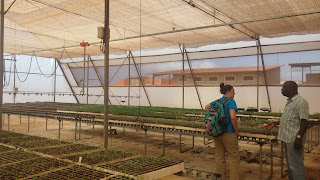
Wednesday, we returned to the Hydroponics Center for a second visit. The director Joao quickly whipped up a meeting with a few staff members so we could sit down and talk more about Wellesley and the potential for collaboration. In addition to him, we spoke with one of the engineers there, a social scientist and an intern to ask them about their work and their ideas for the future. It started off a little slow since I think people were shy but then picked up pace as Mackenzie and I started seeding ideas and others built off of them. It's one thing to talk about thoughts at a table but it's another thing to actually see them. Together, we gathered a list of potential topics to explore there and then they led us outside to show us the topics they talked about: Investigation of renewable, sustainable energy sources (Solar and/or Wind).  They have several large machines necessary in seed sorting/planting, soil mixing, irrigation regulation, and daily office functions ...

Water Productivity: Farmer Interviews

Image
So the following two days were filled with interviewing farmers (in different municipalities and of different backgrounds and resources). And to be honest, it was the most useful thing we've done/seen here. A lot of people can talk and read about practices in Cape Verde but it is entirely different to be there to experience it and talk with the people directly. I believe "going to the source" is the most useful way of understanding anything new. So that's what we did for three days this week. We started off close to the office, speaking with two farmers ( both of whom are allowing us to use their names in publications ). The first, clearly, had experience and resources with farmer and proudly proclaimed he was the one to teach and start strawberry farming on the island. Brief profile (or take-aways): 6 hectares  of very hilly land ( boy, did we walk... ); 3 wells and 5 tanks with programming system for irrigation Believes government should have more dams: says...

Statistics Workshop by "Professor" Christina

Image
Last week, when Paulo brought us to his class of third/fourth-year English students, Mackenzie and I learned that students are required to do a quantitative analytical paper and defend it but  have never been taught statistics or research methods. Many of the students seemed lost and stressed out about having no experience in data collection and analysis. So, as the resident economics major who just finished a course in Econometrics, I offered to do a "statistics workshop" and help them formulate their analysis plan for their research topics. The following Monday (this Monday), it went well: students who had no experience with what we, Americans, claim to be "basic" graphs like  y=mx+b  left the session with an understanding of qualitative versus quantitative data; different types of data; descriptive statistics, regression and ANOVA; and even graph and table options for visualization. I'm really glad I could help them out and it felt great when many came up...

"Draw Before You Think"

Image
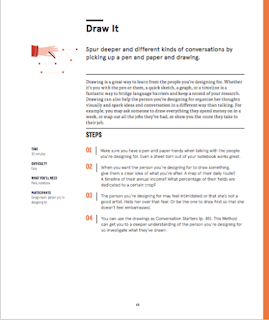
"Draw It" activity from IDEO's  Field Guide Another topic that has also preoccupied my thoughts is the act of observation. What is the least intrusive way I can observe and connect with the people of Cape Verde? How can I minimize the dynamic and disruption that Western/American tourists usually bring? Mayrah Udvardi, who I met during my first year and her last year at Wellesley, developed a wonderful presentation about this topic and presented it at a MaddyTalks - a reunion at the Albright Institute. (Watch below.) I remember when she told me that she had won a Watson Fellowship and was planning on not taking any electronics, drawing the whole experience as she travelled for a year. I was just as much impressed and excited for her as I was worried, considering STEM and architecture fields require a lot of documentation that is usually electronic. Now, after practicing it and hearing this same notion from design professors, I can absolutely say that  drawing ...

Design Methodology

Image
The team at INIDA has a number of topics for me regarding the Santiago Island dams: some of them are outside of my background but others, like technical issues, economic analysis and statistics, are a bit more workable. It would be really interesting to do a report on the technical/engineering as well as the economic and political aspects of the dams. For my other project, at UNI-CV, I am really excited to work with the engineering faculty and find more project-topics with which Wellesley faculty can collaborate. The methods and ideas listed in IDEO's  Field Guide to Human-Centered Engineering  (below) would be really helpful in that phase. Starting the Process IDEO's field guide gives a quick overview of the design process I learned over a semester-long class: there are three phases we can identify as  inspiration, ideation and implementation.  (I remember others using different words but the same idea.)  In both of t...

Service-Learning 101

Image
(Heads up, this is a long post.) Prof. Banzaert recommended three books to me as an introduction to service-learning basics and humanitarian engineering methods: Paul Polak -  Out of Poverty IDEO -  Field Guide to Human-Centered Engineering Kevin M. Passino -  Humanitarian Engineering along with a final project report on Santiago Islands. All of these readings were much better than I expected and offer great advice if interested in doing development work (as an engineer). Out of Poverty Polack describes twelve steps he used "to arrive at solutions to extreme poverty." I am not entirely convinced with his argument that poverty can be "solved" -- but he makes great points at how to go about finding a solution for human-users.  Go to where the action is Talk to the people who have the problem and listen to what they say Learn everything you can about the problem's specific context Think big and act big Think like a child See and do the obv...

Summer Internship 2016!

Image
Long time, no talk! I have finally wrapped up my junior year of college: I am officially a rising senior - and it is still  unreal to think about entering my final year of college. (To those entering or still in college: take advantage of every moment you have.) Fortunately, I will enter the fall semester with a  bang!  as I will have just ended an amazing summer internship in Praia, Cape Verde. Cape Verde is an archipelago composed of ten islands in the Atlantic Ocean, sitting right off of North-West Africa. I was accepted as an intern for the Uni-CV Technical Investigation Internship through the Albright Institute (into which I have also been fortunately accepted for the 2017 program!) and funded by the Anchor Point Fellowship Fund . (A huge shout-out to them both.) There, I am pursuing TWO projects: Dam Poilao management: Working with the government to understand the technical and maintenance issues of the recently established dams on Santiago Island. UNI...

2015 MIT Lincoln Laboratory

Image
This summer, I have been given the great opportunity to join the internship program at MIT Lincoln Laboratory in their Cybersecurity division. Unfortunately, because of the level of security, I cannot discuss my work - and thus the lack of blog posts this summer. However, I have only a week left of the internship program and time has flown by so fast. This summer has absolutely been incredible and I would not trade it for anything. From the facility tours to my summer work to the monthly lunches with Wellesley alums working there, I believe I really explored myself as an engineer  and an economist. While engaging in the culture at the Laboratory, I was forced to reflect on what type of environment I want to work in - academia, government, FFRDC or private sector - and, frankly, I still am not sure as I have no comparison for the private sector outside of a few tours. Regardless, this summer has greatly increased the number of things I need to consider for the field I will choose...

Presenting at the 2014 MA STEM Summit

Image
Director Raji Patel, who also invited me to speak at the Regional Meeting, also asked me to speak at the 2014 Massachusetts STEM Summit during the MASGC breakout session with NASA astronaut and icon Sunita Williams. The talk presented a bit of a challenged as I was asked to condense the presentation of my research on "A Multiplexed Digitizer for Dark Matter Detection" to a holistic, non-technical presentation. I had to re-route the order of my presentation and focus on the "big picture" to my audience. I emphasized my own personal development during the summer, explained major decisions on the overall design of the readout circuit, and featured the importance of such research in the physics and current news arena. (See below.) I was ecstatic to be there alongside Sunita Williams and another student presenting her work. As big of an icon she is, Williams was very cordial and eager to share her experience leading up to her record for "longest single space fli...

The "Multiplexed Digitizer" Talk: MASGC Regional Meeting

Image
When Professor Battat asked if I would be willing to present for the Massachusetts Space Grant Consortium, there was no hesitation in my reply. I could barely contain my excitement as he replied to the director about my response. Not only was the director Raji Patel asking me to present at their regional meeting but also the MA Stem Summit the following week. In just a two-week time period, I would be in the presence of NASA officials, state consortia directors, the Massachusetts Governor, the MA STEM Council (headed by Congressman Kennedy) and other key stakeholders. As excited as I was, I was also nervous about these events: I knew I had to nail it. This morning, at the regional meeting at MIT -- with less than 4 hours of sleep -- I gave the presentation to floor a nation.... maybe that's a hyperbole but my presentation was no less wonderful. My mother -- my greatest supporter and critic -- flew in for this presentation and Wellesley's Family Weekend to place one more laye...

We-Lab and WES: Great Things!

Image
WeLab/WES ( Wellesley Engineering Society ) has gotten off to a great start with almost 100 students and counting . I really want to see the engineering department grow and getting students involved in the seminars, workshops, etc will hopefully retain all those bright-eyed first years interested in engineering. Lookout, World! Wellesley students are ready to show what it means to be An Engineer in Liberal Arts and it's time for people to know about the impact of that tie. As John Maeda says,  STEM + ART = STEAM. Take a look at all the steam these students are building and what's ahead for We-Lab: Can't view infographic? infogr.am/whos-with-me-5283

Introducing... the Wellesley Engineering Society!

Image
Since Prof. Banzaert has been away on maternity leave, I've been working a lot on expanding the presence of the Wellesley Engineering Laboratory and knowledge of the engineering options at Wellesley. I met two other students -- one of who was in my EXTD160 class last Spring (Sam Chin) and the other being a current certificate student (Elena Shaw) -- who are interested in expanding the engineering community here at Wellesley also. With the guidance of Dean Stephan, one of the few members of the engineering steering team, I am pushing forward on my many ideas -- especially the development of a organization for students' interested in engineering for  various levels and fields . This society will engage in field trips to seminars to outreach to conferences to workshops and professional development -- all in the good name of engineering! We have much more interest in the society than I expected and I cannot wait to get things started. My list of seminar topics and field trips i...

A New Semester and PoE

Image
Welcome Back! After a few weeks of break, I am finally back at Wellesley College and ready to take on a new academic year and have just finished the first week of sophomore year. I'm looking forward to diving into Olin's Principles of Engineering, abbreviated to PoE,   (ENGR2210) and Wellesley's Mathematics for the Sciences  in addition to ECON102, ARTH259 and HIST205. What's more, I am helping manage the Wellesley Engineering Laboratory (We-Lab) while the department chair is on leave by organizing seminars, aiding set-up of events (e.g. Engineering Night) and implementing regular "open house" activities. I am now also the program coordinator for the Office of Sustainability's Bike Share Program and a peer tutor for the Physics Department (as well as an individual tutor for ECON101.) Feel free to see me in the Help Room on Thursdays! Since working under Prof. Battat this summer in creating a multiplexed digitizer for dark matter detection, the project...

The Very Last Week

Image
It's Wednesday, July 30th and that means I have less than 6 hours to fully prepare for my poster presentation tomorrow (and pack). This entire week I have fluctuated between PCB layout design in gEDA software and finalizing the internship, though I have made the personal decision to continue my involvement beyond this summer. This entire week has been very active and I barely have time to come up for air. Over the last few days, I have submitted several renditions of the PCB layout, resolving issues such as incorrect traces, lost files, placing components on a dual-sided PCB and more. Most Physics and EE students -- including my advisor -- do/did not design a PCB until graduate school. And, here I am, as a rising sophomore, creating my own PCB. As I mentioned before, this internship has given me more skills than I could possibly imagine. Updates: MUXs are placed on the back-side of the board and connected to the top components with "vias" Two distinct ground planes...

MITES 2014 Reunion

Image
People who know me have heard me constantly credit a high-school STEM program for my "Aha!' moment with electrical engineering and, yesterday, the program held its final presentations ceremony (and alum reunion) for its 39th year in a row. As a rising senior during MIT's Minority Introduction to Engineering and Science (MITES) ten-week summer program, I came in with my mind set on becoming a chemist but was placed in the Electronics design course (my second to last choice). I started the first day of class trying to calm my nerves: "Oh well. I'll make the best out of it." Before I knew it, I had run to call my parents, telling them "I know what I want to do with my life! I want to be an electrical engineer." And my course hasn't changed since. I really have to credit MIT Professor Joe Steinmeyer for developing my love for electronics and encouraging it (e.g. he photocopied his entire Getting Started in Electronics  by Forrest Mims for me)...

Weekend Work: Practice Presentation I

Image
Today was the Plum Island Field Trip and the entire lab took the day off it seems. Yet, that doesn't mean we stop working on our practice presentations for tomorrow or anything else. Between the relaxation periods and the tutor training, I was able to finally email Mr. Knowles the part list for the gyroscope as I kept forgetting. I also finished up a first draft of the PowerPoint presentation (below): I tried to use the CRAP tool (Contrast, Repetition, Alignment, Proximity) in designing my presentation in addition to the advice from Professors Diesl and Conway from the workshop last week. I tried to make each slide as comprehensible in the simplest way possible and rely a lot more on speaker notes and discussion for explanation. First draft came out okay but there's always room for improvement.