Posts

Showing posts with the label Presentation

Women of Color in Graduate School

Image
Recently, I've been asked (by a few people) how it feels to go through graduate school as a woman of color. And, to be completely honest, it's incredibly exciting and exhausting all at the same time. Being a woman of color -- specifically a black woman, particularly in STEM -- has a lot of challenges. If you simply search the phrase "black in graduate school," you will get statistics that are very humbling; articles and think-pieces on how different the Black or person-of-color experience is from students who are not minorities; and other outlets detailing how little support many Black and non-Black students of color feel that they have. In fact, the Council on Graduate Schools recently reported that, in 2017, Black students made up just 11.9% of all first-time graduate students in the United States. (That said, 68% of them were women! So, we are making p r o g r e s s.) I'm not sure what the numbers are at Boston University, but it doesn't seem that far o...

Brainstorming Workshop @ UniCV

Image
This Friday, I took a step to introduce the WeLab teaching style by forming a brainstorming workshop between the UniCV engineering professors and students - and it was a  HIT!  A few days before we prepped by going over the brainstorming activity (below) Professor Banzaert did in my first class with here: what materials do we need, how will we use the most of an hour, what should the environment/vibe feel like, etc. I even got Paulo to agree to help breakdown the formal professor-student division that Cape Verde (and most schools everywhere) cling too. The day of, I was expecting each professor to bring maybe 1 or 2 students but there were  so  many people (20-30 people). After doing a brief presentation on Wellesley (same ECAA presentation) and the brainstorming rules (below), we had to break down into smaller and smaller groups for the activities. Even better, everyone who came was engaged and even wanted to stay longer to fuel more ideas and connections as ...

Water Productivity: Irrigation

Image
Tuesday, we were finally able to see the actual (gota-gota; drip) irrigation system. Regla organized a tour for us to see the irrigation system and management for the fields at INIDA's headquarters in Sao Jorges. We walked quite a bit and through lots of unpaved paths to see the well, reservoir/tank, sand-filters and tubing mechanism in the individual plots. BUT we learned so much that can help us for the paper. I was able to make a lovely sketch (below) that shows the flow of water from macro-scale and at the micro-scale in each plot area. Water is pumped from a well up into an uncovered, cement "reservoir" or tank. This is where water is held for irrigation but, because it is uncovered, it should/needs to be cleaned (a lot). The tank is built at the highest point in order to use gravity to direct the flow of water through large and long tubs into the sand-filters (Japanese made, cleaned every 6 months) and two smaller filters after that. The plots are built like tie...

Presentation at ECAA

Image
Mackenzie and I were invited by the ECAA professors to attend the final round of student presentations on Friday -- and to also present what we are doing too. We weren't quite sure what to expect but we figured the best route would be a short discussion about Wellesley and who we are as well as our two missions -- INIDA and project collaborations. I made a very elegant powerpoint (if I do say so myself) with several photos of Wellesley in order to give them a clearer picture of this "women's college." (See below.) It seems that our presentation was well-received (and my Crioulo was understandable -- yes, this was almost entirely in another language). We got quite a few questions and five ECAA students volunteered to work with us, especially on the INIDA paper. We have a team now! I can't wait to have our first meeting and get to work. I'm glad we are finally making some progress: I just hope we can keep the momentum.

Statistics Workshop by "Professor" Christina

Image
Last week, when Paulo brought us to his class of third/fourth-year English students, Mackenzie and I learned that students are required to do a quantitative analytical paper and defend it but  have never been taught statistics or research methods. Many of the students seemed lost and stressed out about having no experience in data collection and analysis. So, as the resident economics major who just finished a course in Econometrics, I offered to do a "statistics workshop" and help them formulate their analysis plan for their research topics. The following Monday (this Monday), it went well: students who had no experience with what we, Americans, claim to be "basic" graphs like  y=mx+b  left the session with an understanding of qualitative versus quantitative data; different types of data; descriptive statistics, regression and ANOVA; and even graph and table options for visualization. I'm really glad I could help them out and it felt great when many came up...

First Week of Work (02)

Image
Mackenzie and I thought it would be great to attend the first round of student presentations at ECAA to get a feel of the teaching style, students' interests and knowledge, etc. After walking up the huge hill to ECAA (a terrible lapse in judgement), we watched about two-hours worth of presentations. Though everything was in Portuguese, we were able to see a lot of overlap between their topics and our own paper topic -- and we could see what our paper might look like. We also spoke to students there who expressed interest in helping us with our project but only after their final projects are finished (a fair request), and the professors invited us back for the next two rounds. We probably will try to return for at least the last defense. I think the session went over time, so we did not get back to INIDA until after lunch and did not get much work done. Before we knew it, it was time to go and meet with the Parliamentarians. First off, the building looks quite nice an...

First Week of Work

Image
For the first week of work, it was awfully busy: I felt sometimes like a "chicken with its head cut off." The very first day of work for Mackenzie and I, it was a bit slow: we were given two articles to discuss regarding our suggested subject (Water Productivity on Santiago Island) - but we met a lot of cool people who worked at INIDA and connections are key for success. However, the second day of work,  oh my goodness....  We met with Angela about our concerns and interests in the topic and she gave us another article (this one in Portuguese), but she also sent us into Praia to gather data from ANAIS, the federal institute that distributes water production licenses. We had to go that day since a meeting regarding the new administration (and thus the potentially new director) would take place the next day and she could be removed. The director was incredibly helpful and I'm glad we went. She was able to give us a lot of data and highlight issues we probably want to i...

"Draw Before You Think"

Image
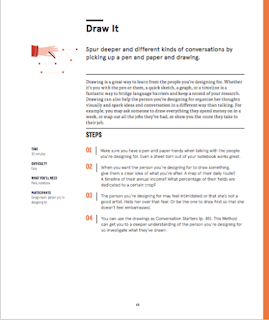
"Draw It" activity from IDEO's  Field Guide Another topic that has also preoccupied my thoughts is the act of observation. What is the least intrusive way I can observe and connect with the people of Cape Verde? How can I minimize the dynamic and disruption that Western/American tourists usually bring? Mayrah Udvardi, who I met during my first year and her last year at Wellesley, developed a wonderful presentation about this topic and presented it at a MaddyTalks - a reunion at the Albright Institute. (Watch below.) I remember when she told me that she had won a Watson Fellowship and was planning on not taking any electronics, drawing the whole experience as she travelled for a year. I was just as much impressed and excited for her as I was worried, considering STEM and architecture fields require a lot of documentation that is usually electronic. Now, after practicing it and hearing this same notion from design professors, I can absolutely say that  drawing ...

And...We're Back!

Image
From " Making Things Making a Difference. " Photo Credit: Amos Chan Hello, again! It has been quite a while since I posted a new entry, primarily because I was abroad all fall and am settling back at Wellesley ( Check out my travels! ). The returning 'culture shock' was much worse than I thought: I don't think anyone prepares for it. Regardless, it's good to be home. A few updates from this Spring semester so far: I am still (and forever will be) interested in engineering and technology. BUT I am taking no STEM classes for the first time in my college career so that I can focus on my Wellesley majors. I am, however, involved in several things: Design for America (BOW Chapter) Wellesley team for the Robot Art Competition ( website is coming ) Wellesley Engineering Society Also, if you didn't see my interview in the Wellesley magazine , check the photo to the right! All in all, I will be posting much more updates to the site but  not as ma...

Final UOCD Product

Image
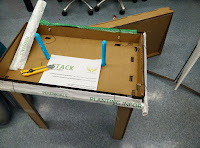
The final poster and prototype, including the flatpack-style box in which all materials are delivered.

Design Review #3

Image
Our third and final review went very well: the instructors praised our ability to dive deeper into the heart of our users and present a bold yet still "simple" product for their opportunity areas of improvement. We decided on pursuing the double-decker garden out of all the ideas from Phase 2: the two-tiered structure would allow plants to grow on both the upper and lower layer. The top shelf is tilted upwards at an angle to allow for a larger window (and thus more sun) for the ground-level bed, and the structure is equipped with insulation curtains that would allow for the plants to survive through the cold weather of December and prismatic crystals can disperse light from the top layer to the bottom layer. Promising research shows a potential development in light, strong cardboard (bridge-like) structures that can hold thousands of pounds, which would lower the cost for our product significantly and allow it to be reusable and formed via flat-pack kit. The goal of our produ...

Phase 3: Develop

Image
"The goals of this phase are to develop, from the perspective of  experience and interaction design, one to two of your promising conceptual directions into more-detailed proposals for products or services that could significantly better the lives of your users and to do so in a way that effectively captures and communicates your extensive thinking through product or service representations." Phase 3 is the third and final portion of UOCD: in this phase, designers are asked to pursue and fully develop one of the project ideas generated through more co-design sessions, table of requirements, while also specifying and building the final product. The team is expected to fully utilize interaction maps, representations of people and products in the product poster along with models and prototypes of the product.

Design Review #2

Image
In general, PLANTS received great feedback on our presentation: we presented a plethora of design ideas for our user group -- some that veered on the  magical  side more than others -- and updated our personas, specifically star maps to indicate emphasis on certain values/project directions. Our ideas ranged from a Garden Co-Op to self-guided interfaces for communal plots to vertical gardening to plot monitoring technology. We created gallery sketches for all of them. We also formed charts that indicated the level of impact-change for the ideas as well as the values of the designers in comparison to the users'. (It is important to identify our own biases in this project.) After taking some of the ideas to users, we marked down their own responses and rankings of values, which allowed us to begin slimming down the project ideas into probable proposals.

Phase 2: CONCEPTUALIZE

Image
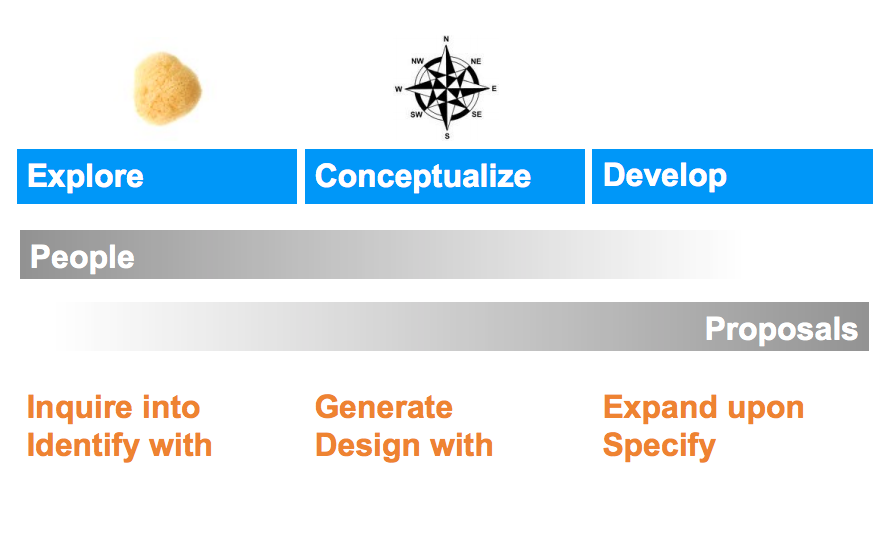
After the Design Review for Phase 1 (EXPLORE), the next class, we were immediately were prepped for the second phase of UOCD: CONCEPTUALIZE. The goal of this phase is "to establish bold conceptual directions in which meaningful contributions could be made to people's lives while evolving your appreciation for and understanding of those lives." Again, the designers should not take the approach of just "design for" but also "design with" and "design by." Thankfully, Prof. Linder and the staff take on a more humble approach to the design project that I think many STEM students could benefit from: "We don't seek to look smart." For Phase 2, the symbol is no longer a sponge but a compass. Now that we have "soaked" and "squeezed" to gather information about our users, it is time to "make sense" of this information. We ended Phase I with our insights about the experience of community gardening, identif...

Design Review #1

Image
The Design Review is a presentation of your progress/results from the first sprint or phase and both faculty and students can give feedback regarding your project. As a group, team PLANTS! organized and rehearsed extensively in preparation. We reflected on the comments given by our section leaders and ninjas at the benchtop reviews (mini sit-downs) and worked together towards what we understood as the expectations for the first phase. The objectives on the course website listed. We assembled the personas, 2x2 maps, mood cards and insight statements generated until this point in order to show our progress and allowed each group member to present on different sections of the presentation: the tools used, different types of people identified, personas and stories, patterns of themes and tensions, and insight statements.We pointed out our starmaps as one of the ways we captured values and indicated uses of other charts for mapping out motivations/values between both ...

More Immersion

Image
Although studio work is an important aspect of the UOCD course, so are lectures. In lectures from Prof. Linder and other staff members, students get to grasp all of the ways in which a project can be tackled. Immersion methods -- ways to engage -- are an example of the broad range of variation as one can rely heavily on the users (Do-Say-Think-Feel) while others rely heavily on the designers (Look-Ask-Try-Why). If the first step of Phase I is to "soak" (like a sponge), the next is to squeeze. LOOK. ASK. TRY. WHY. This (somewhat) mnemonic device helps us remember that we are to be a sponge throughout this phase. To "look" means to be present (in context), descriptive, visual, sensitive and patient with our users: Walking Tour -- the user guides designers through their environment, describing their routines and stories. Show & Tell (Sort) -- the designers observe users take objects from their environments and sort them into categories or on a spectrum (m...

User Visits: Immersion

Image
Part of the EXPLORE phase is engaging the user and one can do so by through meeting directly -- which is exactly what we did. We split the group between two user visits, asked questions, took pictures and made our individual notes (to reflect together later). The entire purpose of meeting with our interviewee was to build this connection with the user, evoking stories and emotions while also shedding light on their reasonings behind actions (which they may have never questioned until this moment). However, our UOCD professors also told us to think outside the traditional interview phase. Immersion Methods It is important to grab the most amount of personality data from any user visit: we want to not only understand  what  they do -- but  how  and  why  they do it. How does their environment influence their decisions day-to-day? Is there other ways of going about the same task? Such questions go deeper into the  person  wh...

Phase I: EXPLORE

Image
For our first assignment, students had to submit a short proposal for what they thought should be considered as one of the user-group options this year. (They change from year to year.) The staff then sorted through them all to narrow down into select choices, on which the students voted for their top three. Based on that information, the staff sorted students into teams per section. As you can see, this blog features the Section 3 group "PLANTS!" -- an all-female design group focused on Community Gardeners and consisting of four Olin and one Wellesley student. Now, diving into the design process, we reach the first phase: EXPLORE. So what does it mean to "EXPLORE"? Each phase has a metaphor describing the user-designer relationship and for Phase I, it is the "sponge." Like a sponge, designers should just absorb any and all observations from the users. Without any filter or side-goal, the students are going into this "all ears" in order to ...