Posts

Showing posts with the label Legos

The Lego Booth: "Science for Girls" Fair

Image
A few weeks ago, I received an email about the Science for Girls chapter hosting a science fair, and, though I was coordinating CommSci at the same time, I thought, " Oh, what's one more activity? " I decided to hold a booth at the event too and expose children/tweens to the "wonders of engineering" -- and the best way I thought I could do that was by hitting close to home: Legos. I have yet to meet a person who does not know about/like playing with Legos. From toddlers, we grow up with building blocks, puzzle toys or the actual Legos themselves, and having just finished the Gear activity, I thought it would be a good activity for a booth. I sent out my idea to several students I knew and few responded back to me. So with a group of four other students (two of which had no experience with Lego robotics), I planned out the activity; did a few lessons in how to build Lego cars, motion modules and PicoCricket programming; prepped for the weekend event; and then...

Sciborg: Day 3/4 -- Feedback and Control (Cont.)

Image
For our third day of working with the Sciborgs, we explored a new system of feedback and control (F&B): proportional control . In the first assignments, we dealt with bang-bang F&B systems, where power was fully on or off throughout the programs, e.g. thermostat, conventional oven. Proportional control is a more efficient way of executing tasks while conserving energy, based on another variable. Part A: Fixed Distance For our first program, we needed to tell Aurora to go 10 feet, by writing an equation for the power supplied to be the product of a constant gain factor and the average of the shaft-encoders : P = Gain x Difference . We were able to write a program (Dist.Pro), where the power decreased as it came closer to the limit (or max number of paces). The second part of Part A required us to add a "Nudge," which means that we set the max paces lower than 10 feet and add a small amount of power for a short period of time to help Aurora reach within 1 cm of 1...

SciBorg: Day 2 -- Feedback and Control

Image
Part C: Working with Fixed Distances For the second part/day with the SciBorgs, we started with a program telling our SciBorg, Aurora, to drive 10 feet (Part C). Having noted how much of counta and countb we would need to compensate for each motor, this activity went rather smoothly. We concluded that, from the Day 1, that signaling the motors to stop when countb equaled 975 equated to roughly 38.9 inches. As 10 feet equates to 120 in, we multiplied by the ratio 120/39, or 3.07, and set the signal for when countb is greater than 3000. Initially, Aurora -- the SciBorg -- was just a hair away from the finish line. We increased the signal for countb to 3005, and we were spot on! We did not have a large problem with skidding or slipping; Only on the ramp did I noticed an increased speed but slower spinning of the wheels (which should not correlate). Part C II: Adding Sensors In adding sensors mechanisms -- touch, ultrasonic, and brightness -- we found the perfect combination with t...

Real-World Feedback Control Systems

Everyday we encounter several feedback-control systems and just to name a few.... 1. Thermostat Probably the simplest and most popular feedback control systems, a thermostat senses the current temperature of a room (sensor mechanism), compares the input to the set or desired temperature (which acts as the control aspect/mechanism), and then either turns the heater "on" or "off" to raise/lower the temperature of the room until it is at or above the "set" temperature (actuation). This system has stood the test of time as it automatically adjusts as needed and maintains a relatively constant temperature. Issues:  The heater is either on full power or off completely, regardless if the room temp. falls a little or a lot below the goal. (As the environmentalist in me speaks out) What a waste of energy! An alternative design would be to use a power proportional to the difference between the desired temp. and current temp, i.e. 20% of power capabilities if ...

Response to Control in an Information Rich World

The article Control in an Information Rich World: Report of the Panel on Future Directions in Control, Dynamics and Systems discusses the elements of feedback control systems and defines "control" as "the use of algorithms and feedback in engineered systems" (7). Likewise, "feedback" allows for correction of controlled systems, operating as "closed loop," ensures that the system will continuously operate correctly under a variety of conditions. -- and they can vary from experimental results to surveys and questionnaires to a leg-kick when a doctor taps your knee. Control systems create quantitative results based on input data, e.g. sensors; they can be adapted to a broad range of subjects and disciplines, including traditional sciences. I particularly thought that the application of such systems for combatting terrorism is very interesting. The idea of control systems as decision-makers is remarkable and speaks to the abilities of the human mind ...

SciBorgs: Day 1 -- Feedback and Control

Image
Last week, my partner Tiffany and I began working with PicoBlock software. Having done some recreational and academic computer programming, I was pleasantly surprised to see how closely the system mirrored traditional program systems/vocabulary, e.g. If-then, If-then-else, etc. The "blocks" method was relatively easy to grasp,but it definitely challenged us at times: understanding Talk-to-abc versus Talk-to-b versus Talk-to-a; remembering to use forever to create a continuous loop of, for example, "print: counta;" or identifying the write sensor port for the right sensor system for data. Part A: Basics We began our exploration by creating basic commands for seven basic movement patterns: Forward, Backward, Brake, Spin-Right, Spin-Left, Bear-Right and Bear-Left . The first three programs? Plain and simple. The last four programs? Not so much. In those commands, we had to instruct the motors to do different things simultaneously. We finally figured out that the b...

Go, Go, Lego Racer!

Image
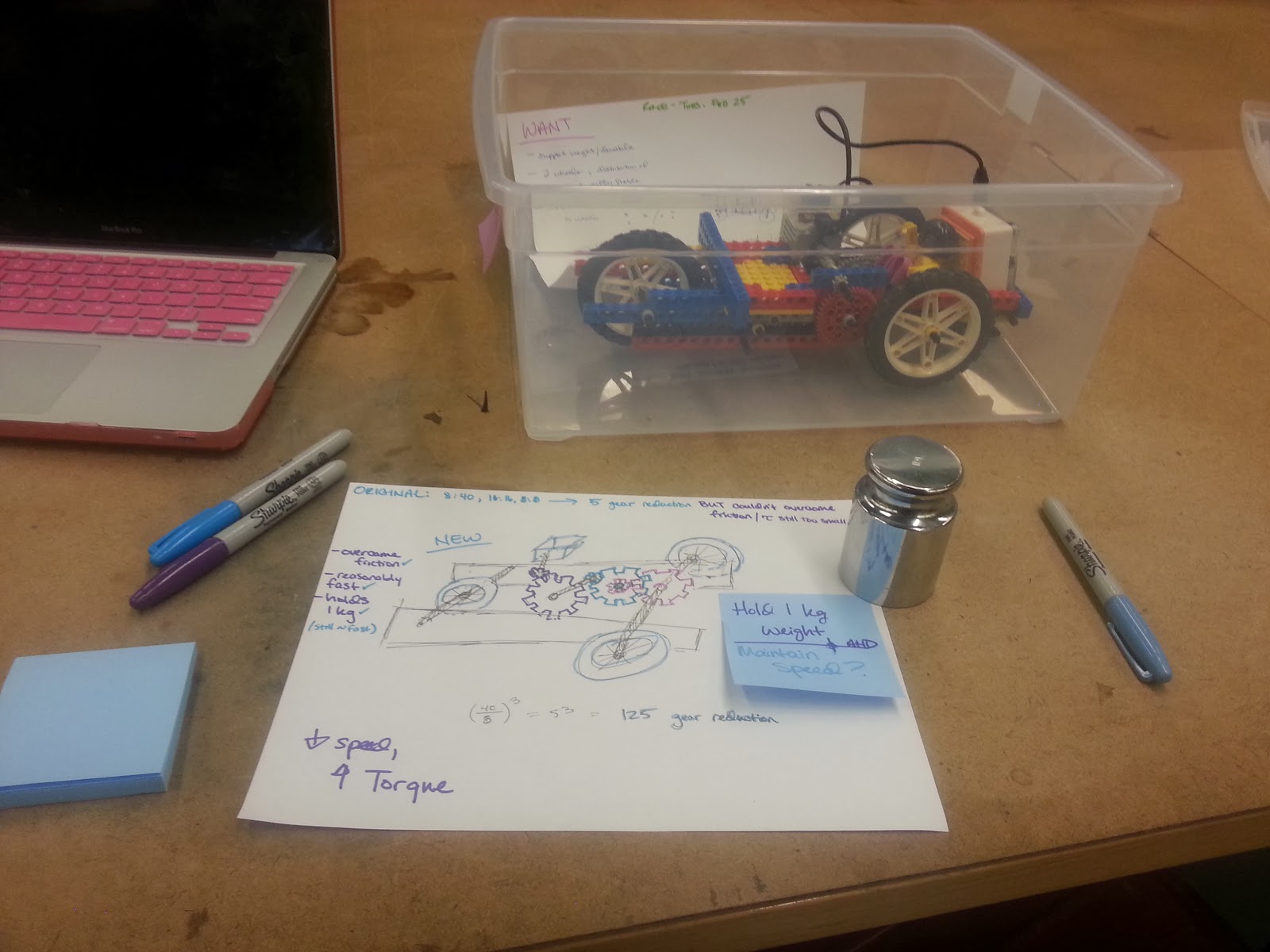
Objective: Discover the "magic" gear ratio to form a (relatively) fast Lego car that can carry a 1 kg weight in a race across a 4 m track. In our first iteration, we had trouble in getting our car to run. In our hands, the wheels would spin wonderfully but, once on the table, the wheels stalled. It then occurred to us what Professor Banzaert had said: "Torque is inversely proportional to speed." We finally figured out that, in order to produce enough power for the wheels -- or the torque -- to overcome the friction of the table (and later the 1 kilogram weight), we needed to decrease the speed. NOTE: Power is torque (τ) multiplied by angular velocity (ω)  or P = τ∗ω.  Also, τ =|F|∗|r|∗cosθ (F = mass of weight times gravitational acceleration 9.8 m/s^2), which translates for gears into |F|∗tanθ and ω=v/r (v = velocity and r = radius of the wheel). To decrease the speed, my partner and I had to increase the gear reduction ratio. Our first car had 3 pairs...