Posts

Brainstorming Workshop @ UniCV

Image
This Friday, I took a step to introduce the WeLab teaching style by forming a brainstorming workshop between the UniCV engineering professors and students - and it was a  HIT!  A few days before we prepped by going over the brainstorming activity (below) Professor Banzaert did in my first class with here: what materials do we need, how will we use the most of an hour, what should the environment/vibe feel like, etc. I even got Paulo to agree to help breakdown the formal professor-student division that Cape Verde (and most schools everywhere) cling too. The day of, I was expecting each professor to bring maybe 1 or 2 students but there were  so  many people (20-30 people). After doing a brief presentation on Wellesley (same ECAA presentation) and the brainstorming rules (below), we had to break down into smaller and smaller groups for the activities. Even better, everyone who came was engaged and even wanted to stay longer to fuel more ideas and connections as ...
Project Scouting: Hydroponics 02

Image
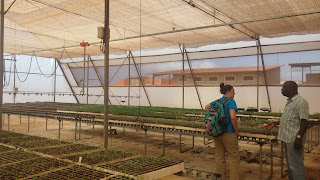
Wednesday, we returned to the Hydroponics Center for a second visit. The director Joao quickly whipped up a meeting with a few staff members so we could sit down and talk more about Wellesley and the potential for collaboration. In addition to him, we spoke with one of the engineers there, a social scientist and an intern to ask them about their work and their ideas for the future. It started off a little slow since I think people were shy but then picked up pace as Mackenzie and I started seeding ideas and others built off of them. It's one thing to talk about thoughts at a table but it's another thing to actually see them. Together, we gathered a list of potential topics to explore there and then they led us outside to show us the topics they talked about: Investigation of renewable, sustainable energy sources (Solar and/or Wind).  They have several large machines necessary in seed sorting/planting, soil mixing, irrigation regulation, and daily office functions ...

WP: Farmer Interviews 02

Image
The second day of interviews was definitely the best! Although many spouted their opinions to us on farmers using traditional irrigation (instead of gota-gota/drip irrigation), it was absolutely amazing to see it in action/finally understand the system and talk to the farmers directly on why they have stuck with traditional systems. We got different opinions and I absolutely want to hear more from that target: We also spoke with two more gota-gota farmers. One is the only member of farmers' association using gota-gota; The other owns a private - and exporting - company. (Note:  Again, all of these farmers are allowing us to use photos and names. ) First things first, traditional irrigation is referred to as " alargamento ," and you really won't understand it unless you see it. This technique is ancient ("since Adam and Eve" as one farmer said) and, generally, farmers learn it from their fathers. We were so lucky to see it in action, because, when you...

Water Productivity: Farmer Interviews

Image
So the following two days were filled with interviewing farmers (in different municipalities and of different backgrounds and resources). And to be honest, it was the most useful thing we've done/seen here. A lot of people can talk and read about practices in Cape Verde but it is entirely different to be there to experience it and talk with the people directly. I believe "going to the source" is the most useful way of understanding anything new. So that's what we did for three days this week. We started off close to the office, speaking with two farmers ( both of whom are allowing us to use their names in publications ). The first, clearly, had experience and resources with farmer and proudly proclaimed he was the one to teach and start strawberry farming on the island. Brief profile (or take-aways): 6 hectares  of very hilly land ( boy, did we walk... ); 3 wells and 5 tanks with programming system for irrigation Believes government should have more dams: says...

Water Productivity: Irrigation

Image
Tuesday, we were finally able to see the actual (gota-gota; drip) irrigation system. Regla organized a tour for us to see the irrigation system and management for the fields at INIDA's headquarters in Sao Jorges. We walked quite a bit and through lots of unpaved paths to see the well, reservoir/tank, sand-filters and tubing mechanism in the individual plots. BUT we learned so much that can help us for the paper. I was able to make a lovely sketch (below) that shows the flow of water from macro-scale and at the micro-scale in each plot area. Water is pumped from a well up into an uncovered, cement "reservoir" or tank. This is where water is held for irrigation but, because it is uncovered, it should/needs to be cleaned (a lot). The tank is built at the highest point in order to use gravity to direct the flow of water through large and long tubs into the sand-filters (Japanese made, cleaned every 6 months) and two smaller filters after that. The plots are built like tie...

Project Scouting: Hydroponics Center

Image
I am really glad I followed my hunch on the hydroponics project. That is an  amazing  facility and one of the most advanced I've seen here. I don't have much experience with hydroponics but from what I've seen, it works really well: the lettuce, tomato, and cucumber plants were absolutely huge! (Thursday, we met with the director Joao Monteiro.) He told us that, with hydroponics setups, you get bigger and more produce: they use a substrate and coconut fibers (to help stabilize the plant) in a pod as the plant grows up a rope. The facility also uses both drip irrigation and mechanical spray system that they sell to farmers. However, all of the water is pumped through an elaborate, advanced valve systems (through which they can regulate fertilizer too): It was a gift from their partner in Spain. They are able to plant so many many seeds so quickly because they also have an advanced seed-sorting and soil-mixing machine from Italy. Both systems have no siblings in Cape Ve...

Presentation at ECAA

Image
Mackenzie and I were invited by the ECAA professors to attend the final round of student presentations on Friday -- and to also present what we are doing too. We weren't quite sure what to expect but we figured the best route would be a short discussion about Wellesley and who we are as well as our two missions -- INIDA and project collaborations. I made a very elegant powerpoint (if I do say so myself) with several photos of Wellesley in order to give them a clearer picture of this "women's college." (See below.) It seems that our presentation was well-received (and my Crioulo was understandable -- yes, this was almost entirely in another language). We got quite a few questions and five ECAA students volunteered to work with us, especially on the INIDA paper. We have a team now! I can't wait to have our first meeting and get to work. I'm glad we are finally making some progress: I just hope we can keep the momentum.