Posts

Robot Art

Image
About a week or so ago, Professor Amy Banzaert - director of the  Wellesley Engineering Laboratory  - sent out an invite to enter an international competition and several students (we) answered the call. We're building a robot to make art! The  2016 1st Annual International RobotArt Competition  aims to foster innovation in artificial intelligence, processing and robotics. Considering that Wellesley is  not  an engineering school (and doesn't have an engineering department), we definitely have our work cut out for us and must be resourceful in our project. We had our first meeting on the Sunday before March and covered quite a bit for an intro into the area: What is robotics?  Have robots been built for painting, decorating, etc? What are our backgrounds?  How can we divide the project into parts? What to do for next time? With all of those questions in mind, we are absolutely seeking to grab more teammates and seek out help in ar...

And...We're Back!

Image
From " Making Things Making a Difference. " Photo Credit: Amos Chan Hello, again! It has been quite a while since I posted a new entry, primarily because I was abroad all fall and am settling back at Wellesley ( Check out my travels! ). The returning 'culture shock' was much worse than I thought: I don't think anyone prepares for it. Regardless, it's good to be home. A few updates from this Spring semester so far: I am still (and forever will be) interested in engineering and technology. BUT I am taking no STEM classes for the first time in my college career so that I can focus on my Wellesley majors. I am, however, involved in several things: Design for America (BOW Chapter) Wellesley team for the Robot Art Competition ( website is coming ) Wellesley Engineering Society Also, if you didn't see my interview in the Wellesley magazine , check the photo to the right! All in all, I will be posting much more updates to the site but  not as ma...

Fall Study Abroad Blog

Image
As many of you know, I have spent this Fall semester in Germany with the IES European Union program, which allows students to visit multiple European countries on topics of EU politics, economics and social policies. I have also taken several personal trips myself that have added tremendously to my experience overseas. Because of this little break in STEM activities, most of my classes are economics-focused and, hence, the lack of STEM posts. BUT I have kept an online blog of my travels: christinaholman-studyabroad.weebly.com ! Check it out.

2015 MIT Lincoln Laboratory

Image
This summer, I have been given the great opportunity to join the internship program at MIT Lincoln Laboratory in their Cybersecurity division. Unfortunately, because of the level of security, I cannot discuss my work - and thus the lack of blog posts this summer. However, I have only a week left of the internship program and time has flown by so fast. This summer has absolutely been incredible and I would not trade it for anything. From the facility tours to my summer work to the monthly lunches with Wellesley alums working there, I believe I really explored myself as an engineer  and an economist. While engaging in the culture at the Laboratory, I was forced to reflect on what type of environment I want to work in - academia, government, FFRDC or private sector - and, frankly, I still am not sure as I have no comparison for the private sector outside of a few tours. Regardless, this summer has greatly increased the number of things I need to consider for the field I will choose...

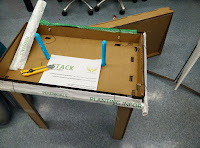
Final UOCD Product

Image
The final poster and prototype, including the flatpack-style box in which all materials are delivered.

Design Review #3

Image
Our third and final review went very well: the instructors praised our ability to dive deeper into the heart of our users and present a bold yet still "simple" product for their opportunity areas of improvement. We decided on pursuing the double-decker garden out of all the ideas from Phase 2: the two-tiered structure would allow plants to grow on both the upper and lower layer. The top shelf is tilted upwards at an angle to allow for a larger window (and thus more sun) for the ground-level bed, and the structure is equipped with insulation curtains that would allow for the plants to survive through the cold weather of December and prismatic crystals can disperse light from the top layer to the bottom layer. Promising research shows a potential development in light, strong cardboard (bridge-like) structures that can hold thousands of pounds, which would lower the cost for our product significantly and allow it to be reusable and formed via flat-pack kit. The goal of our produ...

Phase 3: Develop

Image
"The goals of this phase are to develop, from the perspective of  experience and interaction design, one to two of your promising conceptual directions into more-detailed proposals for products or services that could significantly better the lives of your users and to do so in a way that effectively captures and communicates your extensive thinking through product or service representations." Phase 3 is the third and final portion of UOCD: in this phase, designers are asked to pursue and fully develop one of the project ideas generated through more co-design sessions, table of requirements, while also specifying and building the final product. The team is expected to fully utilize interaction maps, representations of people and products in the product poster along with models and prototypes of the product.